Surface Degreaser Sachets: No Rinse Required
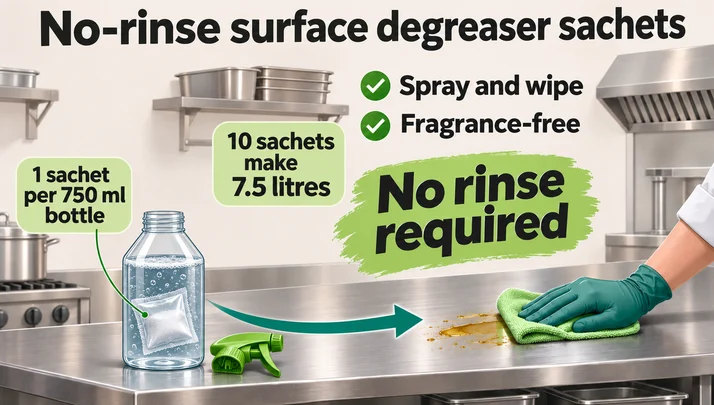
Commercial cleaning teams must strip grease quickly without leaving slippery residues behind. Traditional liquid concentrates rely on measuring jugs, which produces inconsistent dilutions and avoidable chemical waste. Pre-dosed surface degreaser sachets remove that variability. Each water-soluble sachet fixes the concentration inside a single 750ml trigger bottle. Operatives drop one sachet into water, then spray and wipe.
Why pay premium shipping rates for ready-to-use sprays that consist mostly of tap water? Pre-portioned soluble technology cuts transport bulk and holds cleaning performance steady on every shift. Could removing the rinse step from your hard surface cleaning schedule transform labour efficiency across your commercial sites?
Key Takeaways
- SoluCLEAN Surface Degreaser Cleaner sachets produce 7.5 litres of working solution per ten-pack, delivering grease-cutting power at one pound per finished litre.
- The certified method statement confirms no rinsing is required after application, removing an entire operational step from catering and facilities maintenance routines.
- Concentrated powder inside each sachet dissolves fully, so the diluted working solution achieves Not Classified status under European CLP chemical safety regulations.
- Operating at pH 9 to 10 in use, the fragrance-free formula is food-safe and safe on aluminium, stainless steel and treated wood.
- Water-soluble sachets eliminate single-use plastic bottles, and the outer pouch packaging composts once the adhesive paper product label has been peeled away.
Soil Level and Degreaser Selection
Correct degreaser selection depends entirely on the type and volume of oil present on site. Light grease in food preparation areas demands rapid action without chemical taints. Carbonised deposits require heavy-duty chemistry instead. Matching chemical strength to the soil level prevents unnecessary surface wear. It also stops aggressive detergents being wasted on daily cleaning tasks.
The table below compares the standard SoluCLEAN Surface Degreaser Cleaner against the Food-Safe Heavy Duty Degreaser. Application methods, dilution yields and chemical parameters sit side by side. Cleaning supervisors can then deploy the right formulation for daily catering work, engineering maintenance or intensive periodic kitchen deep cleaning.
| Soil Profile | Recommended Product | In-Use pH | Pack Yield | Key Operational Feature |
|---|---|---|---|---|
| Soil ProfileLight to medium animal fats and oils | Recommended ProductSurface Degreaser Cleaner (SCWS750DCPF-10) | In-Use pHpH 9 to 10 | Pack Yield7.5 litres (10 sachets) | Key Operational FeatureNo rinse required; fragrance-free |
| Soil ProfileHeavy carbonised grease and burnt oils | Recommended ProductFood-Safe Heavy Duty Degreaser (SCFS750HDD-10) | In-Use pHAlkaline | Pack Yield7.5 litres (10 sachets) | Key Operational FeatureFormulated for ovens, fryers and extractors |
| Soil ProfileIndustrial machine lubricants and coolants | Recommended ProductSurface Degreaser Cleaner (SCWS750DCPF-10) | In-Use pHpH 9 to 10 | Pack Yield7.5 litres (10 sachets) | Key Operational FeatureSafe on aluminium and painted machine surfaces |
Operational Advantages of No-Rinse Chemistry
Labour Reduction Across Daily Cleaning Rotas
This surface degreaser requires no rinsing after application. Operatives spray the diluted solution onto the contaminated surface, agitate with a cloth, then wipe the emulsified grease away. The freshwater rinse stage disappears completely. That single change cuts the active contact time needed for routine maintenance cleans across busy commercial premises.
High-turnaround catering settings gain real labour savings from a removed process step. Traditional regimes mandate a two-stage wash and rinse cycle. That second stage exists to stop surfactant residue building on work surfaces. The manufacturer method statement confirms no rinsing is required. Staff therefore clean counters, splashbacks and pass-throughs in one wipe pass.
Residue and Smear Control on Hard Surfaces
Skipping a secondary rinse raises fair concerns about residual tackiness or hazing. This surfactant system breaks surface oils down, then flashes off cleanly. The finish is streak-free and residue-free. Preparation counters, high-traffic fixtures and modern composite panels dry clear without any follow-up pass with fresh water.
Inferior degreasers leave alkaline salts behind on the surface. Those salts attract fresh dust and airborne grease within hours. This balanced formulation suspends particulate dirt and grease molecules in the wiping cloth instead. Surfaces then dry uniformly. Polished metals, glazed tiling and clear plastics show no optical distortion afterwards.
Chemical Formulation and Material Safety
Controlled Alkalinity for Hard Surfaces
The in-use pH sits between 9 and 10. That band delivers effective alkaline saponification of fats without aggressive caustic action. Uncontrolled caustics strip grease rapidly, yet they also etch metals and degrade protective sealants. Controlled alkalinity breaks grease down whilst safeguarding delicate commercial installations against chemical pitting.
Many commercial degreasers rely on sodium hydroxide to force grease breakdown. That approach carries severe etching risks on non-ferrous metals. Working within the mild-alkaline spectrum lets this solution saponify fatty acids safely. Facilities teams treat greasy film without stripping anodised coatings. High-grade commercial finishes keep their original appearance.
Broad Substrate Compatibility Across Mixed Estates
This formulation works safely across treated wood, aluminium, stainless steel, vinyl, ceramic tiles, rigid plastic and sealed concrete. Commercial estates carry diverse finishes, which complicates chemical selection for contractors. A single versatile degreaser for hard surfaces covers them all. That choice prevents costly damage from mismatched or corrosive products.
Facility managers oversee mixed architectural materials every day. Heritage buildings frequently sit alongside modern commercial kitchens. Caustic chemicals damage treated architectural timber and dull aluminium extrusions quickly. A stable multi-surface formulation avoids that outcome. Crews move between preparation benches, serving counters and sealed floors without swapping bottles.
Did You Know?
Regulation 6 of the COSHH Regulations 2002 (SI 2002/2677) sets a strict precondition. It applies to all work with hazardous substances. Employers must first make a suitable and sufficient assessment of the risk to health. They must then implement the control steps that assessment identifies.
Packaging Integrity and CLP Hazard Classification
Safer Handling Without In-Use CLP Classification
Neat concentrated powder inside the sachet carries hazard classifications. The diluted working solution is Not Classified under CLP regulations. Operatives never handle raw powder, because the PVA film dissolves entirely in water. Staff simply spray and wipe. Direct chemical exposure disappears, which substantially eases COSHH compliance obligations on site.
Bulk decanting from five-litre bottles remains a leading cause of chemical splashing. Soluble sachet technology seals the concentrated active ingredients inside water-soluble film. The mixed 750ml working solution falls outside CLP hazard thresholds. Site supervisors can therefore drop complicated health surveillance procedures for daily surface cleaning.
Compostable Outer Packaging and Zero Single-Use Plastic
Ready-to-use degreasers generate substantial volumes of rigid plastic waste. That waste complicates corporate waste audits. SoluCLEAN sachets dissolve entirely in water, so no plastic pod remains. The outer flexible pouch is fully compostable. Facilities teams peel the paper label away for general disposal, then compost the pouch.
Corporate sustainability audits now examine packaging waste from subcontracted cleaning operations. Standard rigid trigger sprays need energy-intensive processing to recycle. Compostable film pouches avoid that burden entirely. Paired with permanent trigger bottles, they strip single-use plastics out of the routine chemical supply chain.
60 Litre Free Trial
Request your free 60 litre sample of Heavy Duty Scrubber Dryer Solution
Claim Your Free Samples
Commercial Kitchen Hygiene and Catering Applications
Food-Safe Degreasing Without Fragrance Taint
Commercial kitchens need chemicals that lift cooking fats without perfuming food preparation surfaces. The Surface Degreaser Cleaner contains no added scents. Worktops, preparation tables and pass areas stay taint-free throughout service. The unfragranced profile supports stringent food hygiene standards. Animal fats and vegetable oils still lift away easily.
Food contamination inspections regularly identify chemical taints from floral or citrus perfumes. Those perfumes transfer onto culinary ingredients. An unfragranced formulation protects food preparation integrity across busy production lines. Catering staff clean preparation boards, metallic service passes and hot holding units without introducing volatile aromatic compounds.
Green Colour Coding for Catering Hygiene Compliance
Visual management systems prevent cross-contamination between hygiene zones in catering environments. The SoluCLEAN degreaser system follows the green colour-coding convention, which designates food and catering areas. Green trigger bottles and matching cloths complete the system. That pairing stops kitchen equipment drifting into washroom zones during service.
Catering hubs such as Denton depend on clear visual protocols across high-turnover shift teams. Colour-coded trigger heads and printed matching bottles make each chemical function obvious. Crews recognise the correct product immediately. Washroom and general housekeeping detergents never reach commercial food contact surfaces by accident.
Trade Accounts
Transform your purchasing with our enterprise-grade procurement tool.
Pay By Monthly Invoice
Industrial Maintenance and Workshop Floor Care
Light Oils and Workshop Residue Removal
Industrial workshops present stubborn soil profiles of cutting fluids, machine oil and metallic swarf. Neutral detergents merely spread those petroleum residues across concrete floors, creating hazardous conditions. This alkaline sachet formulation penetrates synthetic oils and greasy films instead. Tool benches, metal casings and inspection benches wipe down clean.
Engineering premises in industrial centres like Darlington face constant oil deposits. Traditional cleaners emulsify mineral lubricants poorly. They leave an invisible slippery boundary across concrete walkways. The targeted surfactants in this sachet system bind to hydrocarbon molecules. Those molecules then release cleanly from floor pores into the wiping substrate.
Slip Risk Control on Hard Floors
Oil deposits on smooth concrete or epoxy workshop floors create an immediate safety risk. This formulation emulsifies hydrocarbon films without a secondary water wash. Operatives restore surface traction rapidly. Fast drying times let maintenance areas reopen promptly, which reduces operational downtime and prevents costly workplace slip accidents.
Wet cleaning passes in transport depots often close vehicle routes and pedestrian walkways. Those closures can run for extended periods. This formulation flashes off without leaving a slippery surfactant residue. Floors return to a safe, dry coefficient of friction quickly. Supervisors avoid elaborate temporary exclusion zones.
Equipment Acquisition
Buy Outright
Full warranty, immediate ownership
Acquire market-leading commercial machinery outright, with full manufacturer warranty and direct delivery from our Selby HQ to site.
Lease Finance
Tax-efficient lease from £24 pcm
Spread the cost over 2, 3 or 5 years with no-deposit leasing on machines over £1,000, plus same-day approval and 7-day UK delivery.
Short-Term Hire
Cover breakdowns and one-off jobs
Hire professional scrubber dryers, carpet extractors and steam cleaners from our Selby HQ for emergency cover or one-off project work.
Manufacturing Lines and Dilution Quality Audits
Fast Turnaround Between Production Shifts
Manufacturing sites clean production lines under strict timetable constraints. A no-rinse formulation accelerates deep sanitisation passes between shifts. Staff complete intermediate degreasing runs without dragging hoses or buckets across assembly areas. Secondary equipment stays off crowded factory floors, which keeps every changeover window short and predictable.
FMCG packing facilities need rapid line clearances to prevent product cross-contamination. Daily production targets leave very little slack. Spraying, wiping and resuming work speeds up product line changeovers noticeably. Compact cleaning kit also removes the trip hazards created by long water hoses and bulky wet-vacuum recovery machinery.
Dilution Control Evidence for Technical Audits
Third-party quality audits penalise uncontrolled chemical dosing and poorly labelled decanted drums. Pre-dosed sachets provide indisputable proof of dilution consistency. One sachet creates exactly one 750ml trigger bottle. Auditors review safety data sheets and pre-printed bottles without questioning whether staff mixed concentrations by eye.
Client technical auditors inspect chemical stores to verify compliance with written method statements. Pre-dosed sachets give every operative identical chemical potency on every shift. Human dilution error disappears entirely. That mechanical consistency supports audit compliance across food production and precision engineering estates.
Built for Your Industry
Hygieia provides products and equipment into the three key UK sectors where cleaning standards run highest. Each card links to that sector’s compliance detail, recommended machines, and live case studies.
Facilities Management
Multi-site contractor support nationwide
Single rolling lease contract across all your customer sites. Replace machines as contracts win or lapse – no capital tied up.
Education & Schools
Safe corridors, term-time delivery slots
Quiet, slip-prevention scrubbers for corridors and halls. Term-time delivery slots designed not to disrupt teaching.
Healthcare & NHS
EN 14476 viral compliance for CQC sites
EN 14476-compliant chemistry and machines that meet Regulation 15 of the CQC cleanliness standards across NHS and care sites.
Procurement Economics and Regional Distribution
Packaging Economics and Cost Per Working Litre
Purchasing managers judge chemical performance on cost per working litre, not upfront bottle price. A ten-sachet pack of SoluCLEAN Surface Degreaser Cleaner costs £7.50. It yields 7.5 litres of working solution, which equates to £1.00 per working litre. This fixed model protects cleaning budgets from over-dosing waste.
True cost per litre comparisons expose the premium attached to pre-mixed ready-to-use trigger sprays. Those sprays also cost considerably more to store. One pack of ten sachets replaces ten individual plastic trigger bottles. Shipping weight falls sharply. Warehouse footprint shrinks at the same time.
Trade Account Terms and Yorkshire Regional Fulfilment
Solupak manufactures SoluCLEAN products in Castleford, West Yorkshire. That plant sits twelve miles from the central Selby warehouse. Trade accounts carry no minimum order requirement and consolidate onto one monthly invoice. Orders placed before 2pm receive same-day dispatch, followed by rapid nationwide delivery to site.
Regional sourcing from Castleford keeps supply chains resilient. It also cuts road freight emissions across regional operations. Contractors access core consumables through a dedicated trade account. A daily price-checked range prevents margin erosion. Deliveries reach site compounds, welfare cabins or central facilities stores within two to three working days.
Get a Trade Quote
Final Thoughts
Grease accumulation across catering, industrial and facilities management sites demands chemistry that performs without disrupting operations. Pre-dosed surface degreaser sachets cut grease reliably and standardise dilution across every team. Removing the secondary rinse step saves considerable labour on every shift. Hygiene standards hold firm in less time.
Concentrated water-soluble technology reduces packaging waste and lightens storage burdens. It also supports stringent corporate sustainability objectives. Commercial estates continue to balance tight budgets against strict health, safety and environmental targets. Controlled dosing systems offer a practical route forward for professional cleaning operations.
Frequently Asked Questions
Q: How much solution does one pack of surface degreaser sachets produce?
A: One pack holds ten SoluCLEAN Surface Degreaser Cleaner sachets and yields 7.5 litres of ready-to-use solution. Each sachet is calibrated for exactly 750ml of tap water inside a reusable trigger spray bottle. The pack costs £7.50, so the chemical cost works out at £0.75 per trigger refill. That equals £1.00 per working litre. Fixed yields remove the waste associated with free-pouring liquid concentrates during routine shifts.
Q: Why does a no-rinse degreaser save commercial cleaning labour?
A: Traditional industrial degreasers need three actions. Operatives apply the chemical, scrub the surface, then wipe it down with fresh water to clear detergent film. SoluCLEAN Surface Degreaser Cleaner is formulated so no rinsing is required on hard surfaces. Operatives spray, wipe away the emulsified soils and leave the surface to dry. Removing that secondary rinse saves substantial labour across kitchens, food processing sites and manufacturing premises.
Q: Is the diluted degreaser solution safe to handle without specialist PPE?
A: The dry concentrated powder inside the sealed sachet carries standard hazard classifications. The diluted working solution is Not Classified under CLP safety regulations. Polyvinyl alcohol film dissolves completely in water, so operatives never contact raw chemical powder. This system lowers COSHH exposure risk compared with pouring liquid concentrates from five-litre containers. Site risk assessments become simpler whilst safety standards across cleaning teams stay high.
Q: Which hard surfaces can be cleaned with this degreaser formulation?
A: The diluted solution operates at pH 9 to 10. It suits a wide range of washable hard substrates. Operatives can safely clean treated wood, aluminium, stainless steel, vinyl flooring, glazed ceramic tiles, rigid plastics and sealed concrete. Controlled alkalinity cuts heavy oils and cooking grease without pitting light alloys. Delicate synthetic surfaces stay clear, which makes the product reliable across complex multi-surface estates.
Q: How does the trade account supply system work for multi-site operations?
A: Trade accounts are free to open and carry no minimum order spend on any product line. Customers pay nothing at the point of order. Purchases across single or multiple premises consolidate onto one monthly invoice. Orders placed before 2pm receive same-day dispatch from the Selby warehouse. Deliveries arrive within two to three working days, including Saturdays, direct to a site, warehouse or facilities depot.