


Multi-Site Cleaning Supplies on a Single Account
Facilities managers and contract cleaners working across multiple locations often struggle with fragmented purchasing. Sourcing multi-site cleaning supplies through retail transactions or mismatched regional stockists creates accounting overhead. It also drains supervisor time. A unified procurement model removes these bottlenecks. Facilities providers can buy commercial paper, chemicals, and durable hardware through one distributor. That approach secures consistent trade pricing across every operational site.
Why should a business waste mobile labour carrying heavy boxes between premises when orders can route straight to where the cleaning happens? Centralising orders whilst sending dispatches directly to site addresses gives transparent oversight. It simplifies bookkeeping and protects daily cashflow. How can cleaning companies apply this structure across scattered regional properties without standing fees or minimum commitments?
Key Takeaways
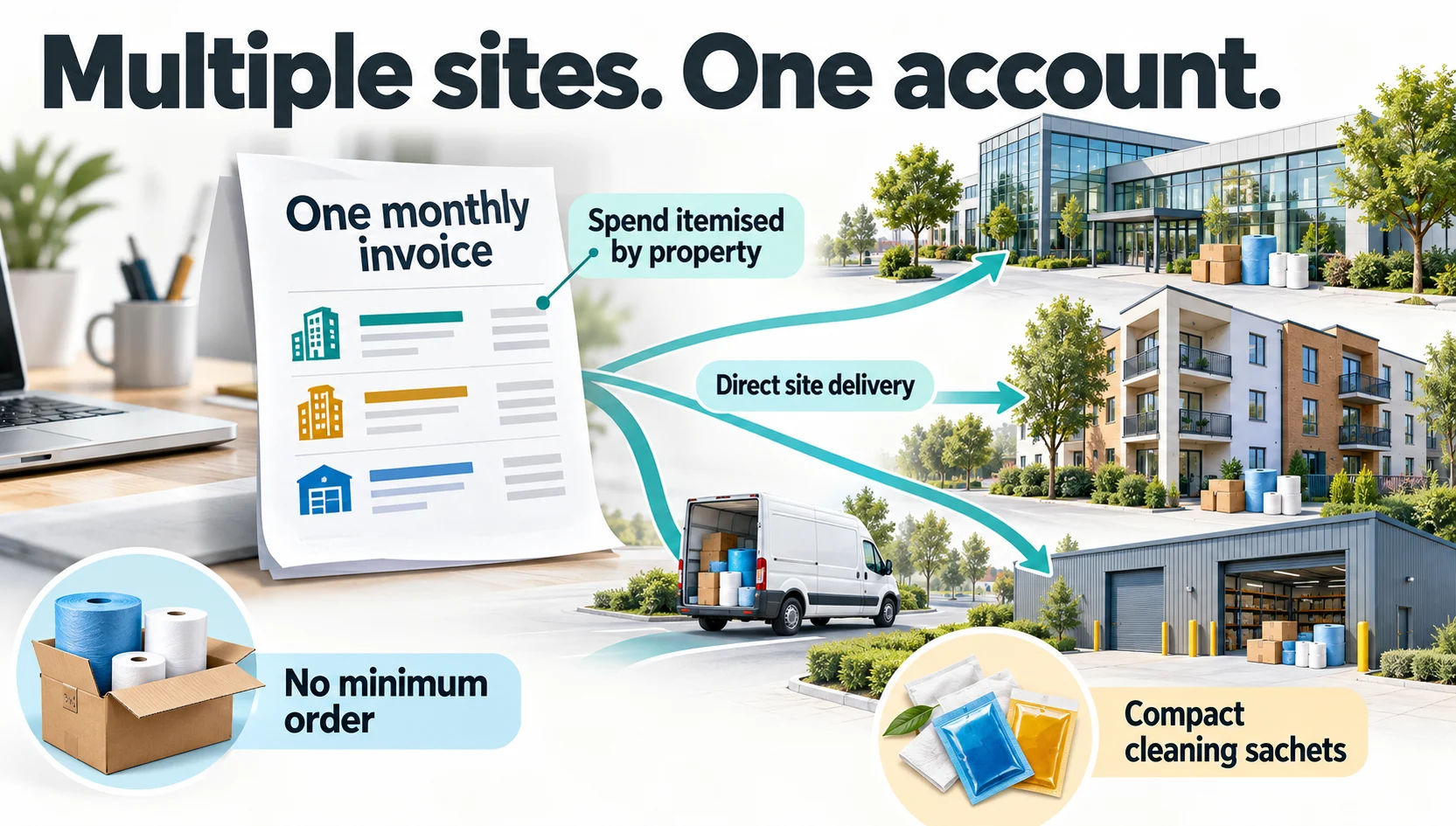
- Consolidating multiple delivery addresses under a single trade facility removes card reconciliation. Cleaners allocate consumables directly to each operational building with complete clarity.
- Direct delivery to client properties eliminates double handling entirely. It stops mobile cleaning teams wasting productive hours shuttling bulky chemicals from central holding depots.
- Itemised monthly invoicing breaks down consumable costs per property. This gives managing agents the exact expenditure records necessary to recharge building service charges accurately.
- Operating without minimum order values allows facility teams to order exact replenishment quantities. Smaller sites receive goods without paying premium rates or holding excess stock.
- Modern waterless concentrate sachets dramatically lower transport bulk. They also simplify on-site chemical storage across distributed housing blocks, managed offices, and commercial facilities.
Consolidated Supply Compared With Fragmented Local Buying
Consolidating janitorial procurement across several properties changes daily cleaning management. Supplying distributed sites from one commercial trade account removes administrative friction. It lowers delivery costs and puts stock exactly where the work takes place. The table below sets out how a centralised trade account compares with legacy purchasing methods across the key operational areas.
Running independent orders across several premises creates financial waste and hidden transport costs. Unified delivery schedules and consolidated invoicing give organisations full oversight of expenditure. In practice, we find this also steadies product quality and curbs chemical over-use. Supervisors then spend their time on contracted service standards rather than on chasing receipts.
| Operational Factor | Fragmented Local Purchasing | Consolidated Account Facility |
|---|---|---|
| Order Administration | Mismatched receipts, multiple credit cards | Single monthly invoice to one named contact |
| Delivery Point | Dropped at central depot or yard | Direct to individual site addresses and storage cupboards |
| Tenant Recharging | Manual estimation across mixed receipts | Fully itemised spend broken down by specific property |
| Minimum Order Rules | Surcharges or forced bulk purchases | Zero minimum order thresholds on any product line |
| Pricing Consistency | Unpredictable retail prices at trade counters | Fixed trade rates applied across every registered site |
Centralised Billing and Account Administration
Single Monthly Invoicing Mechanics
Operating a single trade facility consolidates all regional purchases onto one monthly statement. Instead of sorting through dozens of receipts or managing mismatched credit accounts, finance departments receive one invoice for multiple cleaning sites. This document lists every delivery destination and itemised line, simplifying account balancing and management approval.
In practice, we find that a trade facility works best when buyers are named against specific sites. Each authorised buyer orders for their own building. Every transaction then routes to one accounts payable contact. Nothing is paid at the point of order. The finance team receives one clear statement at month end. Bookkeeper hours fall and invoice disputes become rare.
Cashflow Improvements for Cleaning Contractors
Securing commercial supplies without paying upfront preserves essential operational working capital. Cleaning contractors typically purchase materials in week one of a contract but invoice clients weeks later. Paying immediately for every bottle of chemical strains cash reserves. In contrast, settling monthly invoices aligns consumable outgoings with customer revenue.
This timing structure transforms contract expansion. Mobilising three new office cleaning contracts at once requires substantial inventory. It demands floor pads, trigger bottles, dosing pods, colour-coded microfibre cloths, and washroom paper. Buying those startup supplies on immediate retail terms drains liquid reserves before service revenue arrives. An established monthly trade account removes that capital barrier.
Direct Site Delivery Versus Central Yard Storage
Elimination of Depot Double Handling
Transporting supplies from a central yard out to individual customer premises wastes valuable staff hours. When contractors receive bulk shipments at a central depot, supervisors must unpack, sort, and reload boxes into company vans. Dispatching goods directly to destination addresses removes intermediate handling, protecting vehicles from unnecessary load weights.
Double handling also increases product damage and stock loss. Boxes shifted several times suffer crushed corners, torn paper packaging, and punctured chemical bottles. Loading service vans with heavy paper cases limits the payload left for vacuum cleaners, floor scrubbers, and operatives. Direct delivery brings goods to the working location intact, without spending team labour on internal haulage.
Scheduled Dispatches for Mobile and Night Crews
Night cleaning teams and mobile patrol crews require reliable product access directly within client premises. Having consignments delivered straight to a manned gatehouse, welfare cabin, or secure janitorial cupboard prevents crews arriving to empty shelves. Dispatching orders on a reliable two to three working day schedule keeps operations running smoothly.
Orders placed before 2pm leave the Selby warehouse on the same working day. Dispatches complete within two to three working days, Saturdays included, arriving at the designated building. From experience across the sector, this reliability lets area supervisors order stock during routine Monday site audits. Replenishment then sits inside the property cupboard before the weekend shift begins.
Did You Know?
Regulation 21 of the Workplace (Health, Safety and Welfare) Regulations 1992 sets a legal minimum for washing facilities. Every workplace must provide clean running water, soap or another suitable cleaning agent, and a means of drying. That duty applies at every site an employer operates, not only the head office.
Communal Housing and Residential Block Logistics
Routine Stocking for Residential Communal Areas
Communal housing portfolios require continuous consumable replenishment across stairwells, entrance lobbies, and bin stores. Property managers often struggle to coordinate essential items across scattered locations. These lines include heavy-duty refuse sacks, surface sanitisers, and microfibre cloths. Setting up recurring replenishment profiles ensures caretakers maintain hygiene standards across every shared residential corridor.
Residential bin rooms present problems that demand correct product specification. Lightweight refuse sacks tear when residents discard awkward cardboard or rigid waste. That tear spreads mess across bin store floors. Puncture-resistant 90-litre sacks solve it. Supplying those alongside commercial biocidal sanitisers, delivered to the development itself, keeps shared areas tidy and safe.
Direct Consignment to Individual Blocks
Direct delivery to individual block entrances removes the burden of hauling heavy chemical drums between scattered properties. Housing providers running dispersed estates gain the most from this arrangement. Stock arrives at the property itself, where residential caretakers and mobile cleaners carry out their work. Nobody loads a van to redistribute goods afterwards.
Carrying supplies up multi-storey residential stairwells from a parked utility van causes fatigue and risks injury. Receiving palletised or boxed orders directly into on-site service rooms removes that physical burden. Caretakers unlock the local store, decant their pre-dosed sachets, restock bin liners, and clean the stairwells immediately. No inventory travels across town.
Trade Accounts
Transform your purchasing with our enterprise-grade procurement tool.
Pay By Monthly Invoice
Commercial Workspaces and Multi-Tenant Recharges
Spend Visibility by Individual Commercial Building
Commercial multi-tenant facilities demand precision when tracking cleaning consumable expenditure. Building managers overseeing serviced offices must separate janitorial costs across distinct tenant areas. In practice, we find delivery notes and invoices attributed to individual properties give unambiguous proof of actual product distribution. That evidence settles most tenant queries without further investigation.
Without clear address allocation, finance staff must manually apportion shared chemical and paper bills across separate tenancies. This estimation often causes friction during quarterly lease reconciliations. Clear, site-attributed trade billing isolates the exact expenditure incurred by each individual building. This practice turns raw procurement invoices into clean accounting records.
Transparent Records for Service Charge Audits
Recharging tenants for washroom tissue, hand soap, and cleaning chemicals requires clear evidence during service audits. When invoices group supplies into generic bulk totals, facilities managers spend hours calculating apportioned sums. Itemised invoices that display exact site delivery addresses ensure complete transparency, satisfying commercial lease conditions and managing agent inspections.
Commercial leaseholders increasingly scrutinise service charge statements. Many now request backup receipts for common parts maintenance. An itemised trade invoice showing deliveries of coreless toilet paper, foam soap, and floor degreasers to their building provides verification that is hard to dispute. This clarity speeds up audit approvals and protects tenant relationships.
Equipment Acquisition
Buy Outright
Full warranty, immediate ownership
Acquire market-leading commercial machinery outright, with full manufacturer warranty and direct delivery from our Selby HQ to site.
Lease Finance
Tax-efficient lease from £24 pcm
Spread the cost over 2, 3 or 5 years with no-deposit leasing on machines over £1,000, plus same-day approval and 7-day UK delivery.
Short-Term Hire
Cover breakdowns and one-off jobs
Hire professional scrubber dryers, carpet extractors and steam cleaners from our Selby HQ for emergency cover or one-off project work.
Multi-Region Supply Across County Boundaries
Coordinated Distribution Across Regional Postcodes
Cleaning contractors frequently manage client portfolios that cross borough and county borders. A single mobile firm may hold contracts in several towns at once. From experience across the sector, those operators depend on one national delivery channel. A central account supplies every regional team without separate local trade accounts in each town.
Regional managers avoid dealing with independent merchants in every town. Instead, one central ordering portal dispatches goods from Selby across 94 towns in 11 counties. A crew might clean a distribution depot in Yorkshire or an office block across the Pennines. Delivery standards and dispatch speeds remain identical either way.
Scalable Support for Expanding Service Footprints
Scaling a contract cleaning enterprise into neighbouring counties creates substantial operational and administrative complexity. Establishing separate merchant accounts in every territory produces fragmented buying power and erratic product pricing. Operating through one unified commercial supplier ensures consistent trade rates across every site, regardless of geographic distance from company headquarters.
Contractors bidding on multi-region tenders can forecast supply expenses accurately. They know the price per case of centrefeed or litre of sanitiser stays fixed across every property in their estate. That predictability protects operating margins. It also simplifies contract pricing during competitive client tenders.
Price-Checked Deals
Stock up on our fast-moving wholesale cleaning products today. We constantly monitor these price-checked deals to lower your commercial overheads..
Standardised Product Specification Across Sites
Core Consumables and Consistent Specification
Standardising core consumables across every site prevents quality discrepancies and controls operational expenditure. The bulk of contract consumable budgets involves six fundamental lines: refuse sacks, centrefeed, nitrile gloves, microfibre cloths, hand soap, and washroom paper. Sourcing verified, price-checked versions of these essentials guarantees dependable performance across every client building.
When cleaners buy materials from varied local cash-and-carries, product quality fluctuates wildly. Thin refuse sacks split easily. Cheap centrefeed disintegrates when damp, and non-certified gloves tear during basic tasks. Standardising across a vetted range ensures every operative works with reliable materials that meet consistent health and safety standards.
Storage Savings Through Compact Concentrate Sachets
Constrained janitorial cupboards across multi-site estates often lack the physical room needed for traditional five-litre chemical drums. Pre-dosed water-soluble sachets solve this spatial challenge by requiring 96% less storage space than ready-to-use liquid alternatives. Cleaners simply drop a sachet into water, eliminating measuring errors and removing bulky storage drums.
The soluCLEAN range, manufactured in Castleford, cuts chemical costs by roughly 60% against ready-to-use triggers. A compact carton holding fifty floor cleaner sachets makes 500 litres of working solution at two pence per litre. Removing heavy plastic bottles saves cupboard space, cuts haulage weight, and prevents chemical over-dosing on site.
Built for Your Industry
Hygieia provides products and equipment into the three key UK sectors where cleaning standards run highest. Each card links to that sector’s compliance detail, recommended machines, and live case studies.
Facilities Management
Multi-site contractor support nationwide
Single rolling lease contract across all your customer sites. Replace machines as contracts win or lapse – no capital tied up.
Education & Schools
Safe corridors, term-time delivery slots
Quiet, slip-prevention scrubbers for corridors and halls. Term-time delivery slots designed not to disrupt teaching.
Healthcare & NHS
EN 14476 viral compliance for CQC sites
EN 14476-compliant chemistry and machines that meet Regulation 15 of the CQC cleanliness standards across NHS and care sites.
Account Facilities Without Restrictive Commitments
Purchasing Flexibility Without Minimum Orders
Most traditional janitorial wholesalers enforce restrictive minimum order thresholds that penalise smaller branch locations. When a small office needs a single case of blue roll, minimum order rules force managers to buy unwanted surplus or pay retail rates. Sourcing through accounts with no minimum order ensures equal pricing on every line.
A single case carries the same unit trade price as a full pallet. Pallet deliveries reduce transport frequency on high-volume distribution sites. Even so, smaller satellite properties can order single boxes without penalty. This flexibility prevents clutter in tight cleaners’ cupboards. It also stops capital stagnating on storeroom shelves.
Straightforward Onboarding for Commercial Facilities
Setting up a comprehensive trade facility should never require complex financial hurdles or lengthy application delays. Any commercial enterprise, whether an independent cleaning business or an in-house facilities department, can register without subscription charges or annual commitments. Opening an account requires basic company details, designated delivery addresses, and a primary invoicing contact.
Holding a dedicated multi site janitorial account incurs no maintenance fees. There are no dormancy penalties if ordering pauses between contracts. Companies can register dozens of delivery postcodes under one commercial roof. That gives operational agility whenever new client premises join the service portfolio.
Get a Trade Quote
Final Thoughts
Efficient facilities management relies on simplifying supply logistics and removing administrative friction. Sourcing multi-site cleaning supplies through one well-managed commercial account gives cleaning contractors and property managers full control. They can hold hygiene standards across multiple properties without added effort. Consolidating orders, automating site-specific deliveries, and centralising billing transforms everyday procurement.
As commercial property portfolios expand and sustainability requirements tighten, procurement efficiency will define profitable cleaning operations. Compact dissolvable chemical formats and direct-to-site delivery let facilities teams cut their carbon footprint whilst holding budget discipline. Robust supply structures built today support stable service delivery across every commercial site for years to come.
Frequently Asked Questions
Q: How does invoicing work when ordering supplies for several different cleaning locations?
A: Orders route to their respective site addresses whilst all charges consolidate onto one monthly invoice. The statement goes directly to your nominated finance contact. It lists each purchase by delivery address, date, and product line. This breakdown removes the task of reconciling disparate payment cards. Finance teams receive clear records for allocating expenditure across contracts or commercial buildings, without extra administration or approval delays at month end.
Q: Can cleaning supplies be delivered directly to secure site cupboards or gatehouses?
A: Consignments go directly to any nominated commercial address. Destinations include manned security gatehouses, facilities storage cupboards, or welfare cabins. Goods ordered before the 2pm cut-off leave the warehouse the same day. They arrive within two to three working days, Saturdays included. Delivering straight to client premises stops supervisors and mobile cleaning teams wasting shift time. Crews avoid carrying bulky paper goods and chemicals between central yards and sites.
Q: Is there a minimum order spend required for individual branch deliveries?
A: No minimum order value applies to any line on the account. Individual sites can receive single cases of washroom paper, hand soap, or sanitiser. They pay the same trade price charged on larger pallet volumes. This flexibility stops smaller branch offices or residential properties stockpiling surplus inventory they cannot easily store. Managers order precisely what each location requires, without low-order financial penalties or inflated retail rates.
Q: How do multi-site accounts help managing agents recharge tenants for cleaning consumables?
A: Managing agents need precise documentation to recharge shared consumable costs under commercial service charge agreements. A multi-site account itemises every dispatch by physical building address. The invoice shows exactly which quantities of soap, paper towels, and cleaning chemicals went to each property. That accounting record satisfies service charge audit requirements. It removes guesswork and lets property managers present firm expenditure evidence to leaseholders during annual reconciliations.
Q: What details are required to open a multi-site commercial trade account?
A: Opening a multi-site commercial trade account requires basic operational information. You provide your trading business name, company registration details, a primary invoicing contact email, and designated delivery addresses for your cleaning contracts. The facility is free to open and carries no annual subscription fees. It requires no minimum monthly spend and charges nothing at the point of order. Any organisation cleaning its own or third-party premises can register.