
York Janitorial Supplies: Open a Trade Account Today
Facilities managers and independent cleaning contractors require dependable access to York janitorial supplies. Reliable stock maintains strict hygiene standards across commercial premises. Sourcing professional-grade chemicals, paper products, and floor machinery often presents unnecessary procurement friction. Many suppliers impose restrictive order thresholds, slow delivery turnarounds, or erratic wholesale pricing structures that undermine operating margins. Reliable local supply routes resolve these procurement challenges directly. They guarantee continuous access to high-performance stock. This access allows cleaning operations across North Yorkshire to run smoothly, safely, and efficiently throughout the calendar year.
How can commercial cleaners balance tight budgets whilst securing certified chemicals and commercial machinery without restrictive purchasing commitments? Facilities teams must evaluate credit terms, delivery logistics, and regulatory compliance standards before choosing a trade partner. Which procurement model delivers genuine cost efficiency and operational resilience for commercial cleaning operations across the region?
Key Takeaways
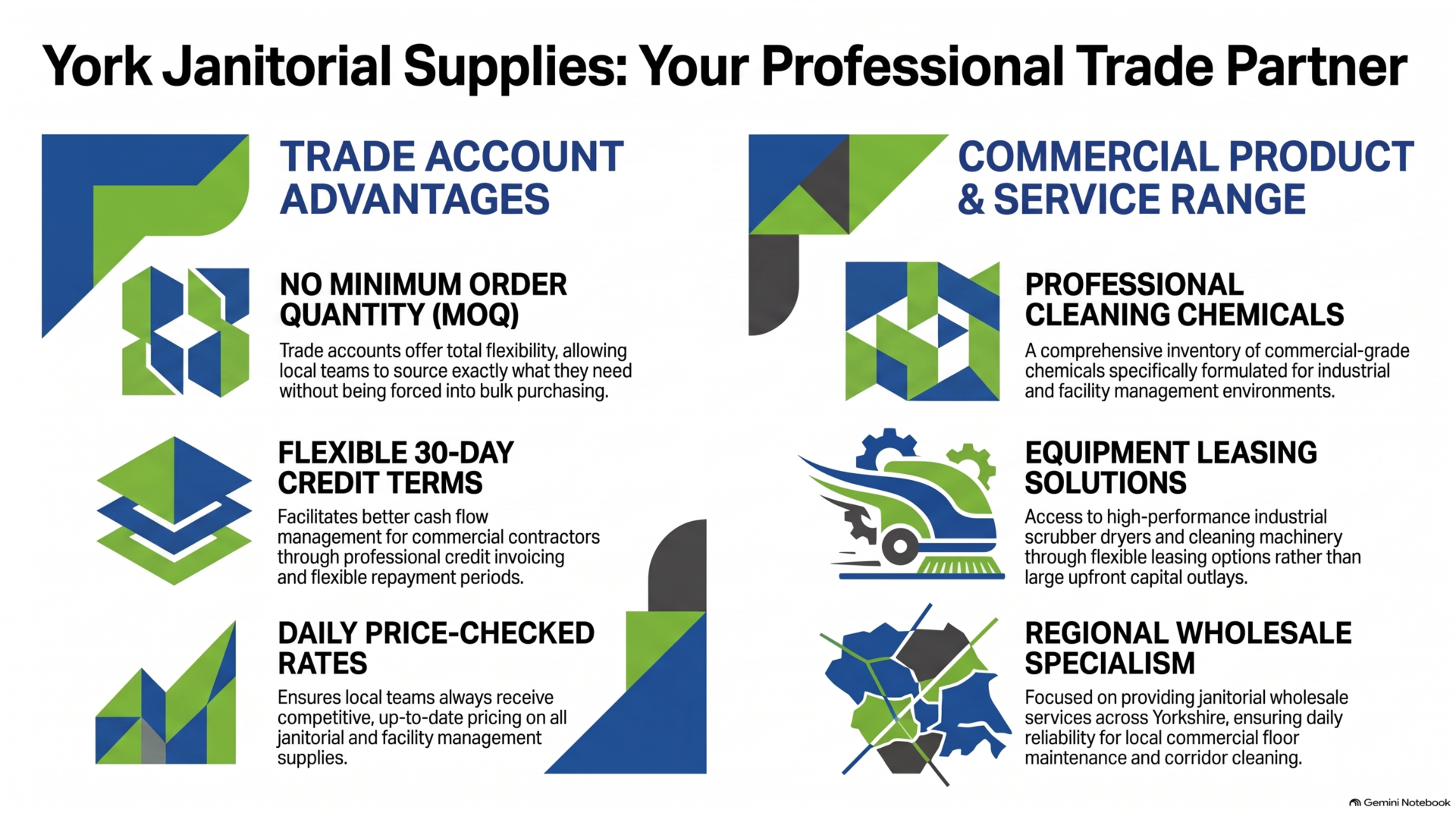
- A commercial trade account provides thirty-day credit terms, which simplifies procurement administration and protects contractor cashflow across multiple client sites throughout Yorkshire.
- Daily price checking against national wholesale benchmarks guarantees that local contractors pay competitive trade prices on high-volume chemicals, paper products, and protective equipment.
- Purchasing cleaning stock with no minimum order quantities prevents capital tie-up and eliminates artificial order padding for small contractors and single-site facilities.
- Tax-efficient equipment leasing preserves valuable operational working capital whilst giving cleaning teams access to modern, high-productivity floor care technology like commercial scrubber dryers.
- Rigorous compliance with EN 14476 virucidal standards and British Institute of Cleaning Science colour coding ensures premises remain audit-ready for regulatory inspections.
Commercial Janitorial Procurement Comparison
Professional cleaning operations must balance speed, capital expenditure, and administrative efficiency when procuring janitorial supplies. Selecting the correct account framework determines whether a business retains cash reserves or suffers administrative drag. Facilities managers frequently compare standard retail buying against structured trade credit models to establish predictable expenditure patterns.
The following comparison highlights key operational differences between ad-hoc retail purchasing and dedicated trade account procurement. It demonstrates how structured invoicing, flexible minimum order rules, and dedicated local distribution networks impact commercial margins. Evaluating these core procurement parameters helps teams select the most cost-effective supply strategy for their ongoing maintenance contracts.
| Procurement Metric | Ad-Hoc Retail Purchasing | Dedicated Trade Facility |
|---|---|---|
| Cashflow Impact | Immediate card debit on every transaction | Consolidated thirty-day net settlement terms |
| Order Thresholds | Rigid minimum spend or retail surcharges | True trade account with no MOQ on core stock |
| Technical Compliance | Limited COSHH data sheets or traceability | Full EN certification sheets and audit support |
| Pricing Stability | Fluctuating shelf prices with retail markups | Verified trade price cleaning supplies with daily checks |
Commercial Credit Facilities for Cleaning Contractors
Cashflow Protection Through Consolidated Billing
A commercial trade account replaces fragmented card payments with a single monthly statement. Instead of reconciling dozens of individual receipts, contractors settle all purchases on thirty-day net terms. This approach frees working capital and simplifies book-keeping. It ensures teams maintain an uninterrupted supply of cleaning chemicals across multiple active customer sites.
Administrative friction escalates rapidly when buying stock piecemeal. A contractor managing eight commercial sites might place eight separate orders every month. Retail purchases require eight distinct bank transactions, multiple receipts, and repeated card authorisations. A thirty-day net trade facility merges these orders into one monthly statement. The invoice provides itemised cost-centre breakdowns for every location. This consolidation saves administrative hours, simplifies VAT returns, and preserves cash reserves for essential payroll commitments.
Operational Priorities for Account Holders
Dedicated trade account customers receive direct operational priority across stock allocation and customer support channels. Priority handling safeguards contract performance by ensuring rapid stock access during unexpected supply chain shortages. Dedicated communication routes connect buyers directly with experienced product specialists. These specialists understand commercial facilities, regulatory compliance, and immediate site requirements.
Standard retail buyers often suffer unannounced out-of-stock notices during national supply pinches. Trade account holders secure priority back-order allocation on critical consumables like nitrile gloves and clinical disinfectants. Account holders also receive early notifications regarding chemical reformulations and bulk price adjustments. Dedicated trade desks help facilities teams resolve technical equipment challenges quickly. This reliable operational backing transforms routine purchasing into an enduring commercial partnership that protects service delivery standards.
Wholesale Pricing Disciplines and Market Verification
Daily Market Rate Verification
Daily wholesale price checking guarantees commercial contractors receive genuine trade rates across every stocked line. Proactive monitoring prevents wholesale cost creep. It eliminates the unannounced price hikes common in janitorial distribution. This systematic auditing ensures facility managers procure high-grade cleaning supplies affordably. Stocked lines consistently match or beat national wholesale benchmarks.
Janitorial wholesale often conceals opaque price tiers. Many distributors offer discounted introductory rates before inflating everyday consumable costs over time. A transparent daily price-check system eliminates this risk. Teams monitor major UK trade distributors every working morning to match or beat active market rates. Sourcing verified trade price cleaning supplies under this transparent model protects profit margins on fixed-price annual facilities maintenance contracts.
Consumables Expenditure and Value Verification
Trade buyers frequently overpay on high-volume essentials like washroom paper, degreasers, and gloves. Purchasing unverified retail goods or cheap marketplace alternatives often compromises quality and safety. Verified wholesale specifications provide professional chemical concentrations and certified durability. Full batch traceability prevents costly false economies in demanding commercial environments.
Cheap retail cleaning products usually contain more than ninety percent water. Shipping diluted fluids inflates transport costs and consumes valuable depot storage. Professional concentrated formulas and water-soluble sachets resolve these inefficiencies directly. The SoluCLEAN dosing system, for example, reduces chemical procurement spend by up to sixty percent. Pre-dosed sachets eliminate manual dosing errors, protect surface finishes, and guarantee full COSHH compliance across the workforce.
Did You Know?
Under the UK’s Simpler Recycling reforms, businesses and non-domestic premises with ten or more full-time equivalent staff have had to separate food waste and dry recyclables from general waste since the 31st of March 2025, with a separate mandatory digital waste tracking regime following for licensed waste-receiving sites from the 1st of October 2026.
Regional Fulfilment and Warehouse Collection Logistics
Scheduled Yorkshire Delivery Routes
Scheduled local delivery routes provide reliable replenishment of bulky chemicals and paper cases. Coordinated delivery runs throughout Yorkshire ensure commercial sites receive heavy drums safely. This system avoids reliance on fragile national parcel courier networks. A dedicated fleet reduces transit damage and guarantees predictable arrival windows for busy teams.
National parcel networks frequently damage high-mass chemical drums and multi-case paper consignments during transit hub sorting. Dedicated regional delivery vans eliminate these risks. Drivers transport palletised goods, concentrated fluids, and machinery directly to customer storage bays. Orders placed before afternoon cut-off periods receive prompt dispatch. This predictable schedule allows facility managers to plan restocks around building intake hours and site access constraints.
Trade Counter Collection Protocols
Trade warehouse collection provides an immediate solution for contractors requiring urgent supplies. Pre-arranged collection protocols allow cleaning crews to pick up stock directly from trade counters. This avoids waiting for scheduled van drops. Direct collection resolves sudden emergency requirements and prevents costly contract work stoppages on active sites.
Contract handovers and emergency spills often demand immediate access to specialist remediation fluids, replacement hoses, or floor pads. Contractors can phone orders through in advance to initiate immediate picking at the trade counter. Staff stage the items for fast handover upon arrival. Presenting a valid purchase order and trade credentials completes the transaction in minutes. This immediate counter service keeps cleaning teams operational when unexpected site challenges occur.
Trade Accounts
Transform your purchasing with our enterprise-grade procurement tool.
Pay By Monthly Invoice
Zero Minimum Spend Barriers for Growing Businesses
The Operational Impact of Minimum Order Quantities
Traditional wholesale distributors frequently enforce high minimum order thresholds. These spend rules place significant financial pressure on smaller commercial cleaning enterprises. High thresholds force operators to tie up working capital in unnecessary stock. Removing minimum order rules allows businesses to purchase exact quantities. This flexibility protects cashflow and improves depot storage efficiency.
Many janitorial suppliers impose minimum order thresholds of one hundred and fifty to five hundred pounds. These rules compel smaller contractors to purchase excess products simply to complete an order. This practice clutters cleaning cupboards with slow-moving inventory and depletes short-term cash reserves. Abolishing mandatory minimums allows businesses to order precise supplies for specific jobs. Removing these financial hurdles gives emerging cleaning companies the operational agility needed to succeed.
Single-Unit Wholesale Pricing Integrity
Operating a trade account with no MOQ ensures service providers secure wholesale pricing without bulk commitments. Contractors purchase single five-litre drums or individual glove boxes at standard trade rates. This purchasing equity protects small cleaning companies. Independent operators compete fairly against national corporate providers without sacrificing operating margins.
Bulk discounts remain valuable for large commercial teams ordering full pallets of paper products or black refuse sacks. However, single-item wholesale access allows contractors to purchase specialised formulas without substantial capital outlays. Cleaners can purchase a single pack of biological washroom descaler or traffic-lane pre-spray for a targeted contract. This low-risk access enables independent teams to take on diverse commercial cleaning jobs profitably.
Equipment Acquisition
Buy Outright
Full warranty, immediate ownership
Acquire market-leading commercial machinery outright, with full manufacturer warranty and direct delivery from our Selby HQ to site.
Lease Finance
Tax-efficient lease from £24 pcm
Spread the cost over 2, 3 or 5 years with no-deposit leasing on machines over £1,000, plus same-day approval and 7-day UK delivery.
Short-Term Hire
Cover breakdowns and one-off jobs
Hire professional scrubber dryers, carpet extractors and steam cleaners from our Selby HQ for emergency cover or one-off project work.
Commercial Floor Machinery Acquisition Framework
Capital Purchase Versus Operational Leasing
Selecting between outright machine purchase and asset finance requires careful financial evaluation. Buying equipment outright suits businesses with surplus capital and predictable long-term contracts. Conversely, operational leasing spreads costs over predictable monthly instalments. This financing model preserves vital working capital for daily operational needs and payroll demands.
Modern floor cleaning machines substantially improve on-site productivity. For instance, the i-mop XL scrubber dryer cleans up to 1,800 square metres per hour. Yet purchasing high-performance machinery outright requires significant upfront cash reserves. Commercial leasing agreements over two to five years spread the cost into manageable monthly payments. These lease payments qualify as deductible business expenses against corporation tax, allowing businesses to modernise equipment fleets without draining reserves.
Short-Term Hire for Project Work
Short-term machinery hire provides tactical flexibility for one-off deep cleans or seasonal shutdowns. Facilities managers access industrial carpet extractors and rotary scrubbers without long-term commitments. This acquisition route fulfils specific client contract specifications promptly. Contractors deliver flawless results whilst containing their capital expenditure effectively.
Periodic contract deep cleans often require specialised equipment that sits idle during routine maintenance. Purchasing industrial carpet extractors like the Truvox Hydromist or rotary scarifiers for occasional tasks ties up funds pointlessly. Short-term hire provides access to fully serviced machinery precisely when required. Costs match project billing cycles directly, protecting profit margins whilst fulfilling demanding contract specifications with professional equipment.
Price-Checked Deals
Stock up on our fast-moving wholesale cleaning products today. We constantly monitor these price-checked deals to lower your commercial overheads..
Disinfection Standards and Healthcare Compliance
EN 14476 Virucidal Efficacy Standards
Chemical disinfection within healthcare and education demands verifiable testing standards to guarantee safety. The European Standard EN 14476 defines rigorous virucidal efficacy benchmarks for disinfectants. Cleaners must verify independent laboratory test data. Authentic certification proves the solution destroys harmful viral pathogens within stated dwell times on high-touch surfaces.
Domestic retail sanitisers often make vague antimicrobial claims without third-party laboratory verification. Professional formulations, such as SoluCLEAN Anti-Viral Cleaner and Selgiene Ultra, undergo stringent independent testing against demanding viral pathogens. These chemicals deliver proven efficacy against Norovirus, Hepatitis, and Coronavirus within certified contact times. Using EN 14476 certified disinfectants ensures that commercial facilities maintain reliable infection control barriers in high-risk communal areas.
Evidence Trails for Care Quality Commission Audits
Healthcare providers under Care Quality Commission oversight must maintain detailed cleaning audits. Inspectors evaluate cleaning logs, dilution charts, and safety data sheets. These records verify clinical hygiene integrity across all patient areas. Implementing traceable chemical systems and accredited hardware provides the evidence trail required during statutory inspections.
Care Quality Commission Regulation 15 requires premises and equipment to remain hygienic and clean. Inspectors assess physical surface cleanliness alongside cleaning procedures and technical documentation. Deploying colour-coded dosing bottles alongside clinical surface wipes like Sani-Cloth AF3 satisfies audit criteria. Pairing compliant chemistry with medical-grade HEPA vacuums, such as SEBO BS360 uprights, proves that cleaning regimes consistently follow national healthcare hygiene standards.
Built for Your Industry
Hygieia provides products and equipment into the three key UK sectors where cleaning standards run highest. Each card links to that sector’s compliance detail, recommended machines, and live case studies.
Facilities Management
Multi-site contractor support nationwide
Single rolling lease contract across all your customer sites. Replace machines as contracts win or lapse – no capital tied up.
Education & Schools
Safe corridors, term-time delivery slots
Quiet, slip-prevention scrubbers for corridors and halls. Term-time delivery slots designed not to disrupt teaching.
Healthcare & NHS
EN 14476 viral compliance for CQC sites
EN 14476-compliant chemistry and machines that meet Regulation 15 of the CQC cleanliness standards across NHS and care sites.
Cross-Contamination Control and Waste Regulations
The Four-Colour Hygiene System
The British Institute of Cleaning Science colour-coding framework provides a universal hygiene standard. This system prevents harmful cross-contamination across commercial premises. Segregating cleaning equipment into four colour zones protects different facility environments. Washroom pathogens never contact food surfaces or office desks. Consistent colour separation protects public health and simplifies daily staff supervision.
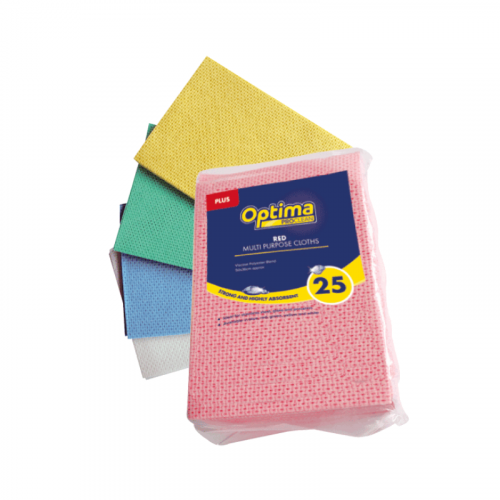
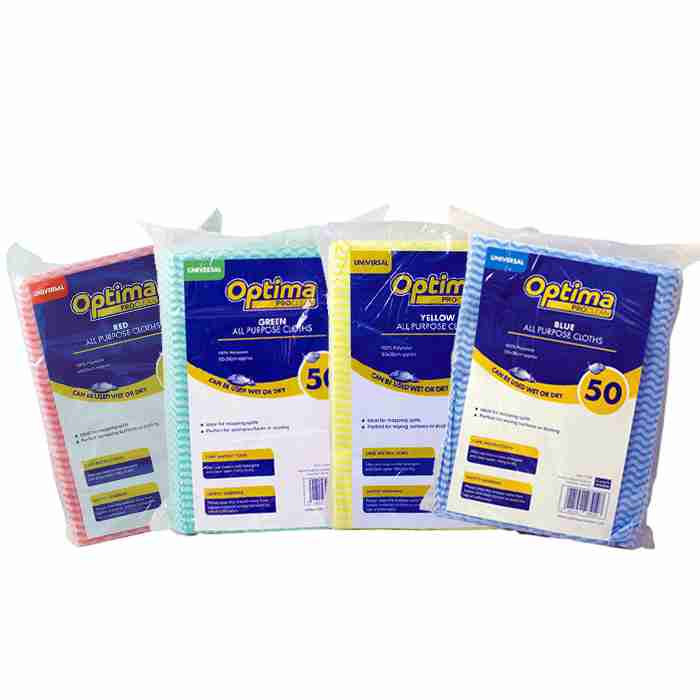
The BICSc system divides tools into four distinct operational categories. Red designates high-risk washroom toilet fixtures. Yellow covers clinical areas, washbasins, and secondary washroom surfaces. Green applies strictly to commercial catering and food service areas. Blue denotes low-risk communal zones like offices and classrooms. Using matching microfiber cloths, mop handles, and colour-coded chemical containers prevents cross-contamination and reassures environmental health auditors.
Statutory Waste Segregation Duties
Commercial waste management requires strict adherence to statutory duty of care responsibilities. Cleaning contractors must segregate dry recycling, food waste, and general rubbish. Utilising certified refuse sacks ensures compliance with environmental regulations. Quality liners prevent bag splits and fluid leaks in communal bins. Proper waste handling protects premises from costly statutory penalties.
UK businesses must retain legal Waste Transfer Notes for at least two years to verify proper disposal through registered carriers. Food waste segregation rules require certified compostable liners conforming to BS EN 13432 standards to ensure decomposition in industrial processing centres. Providing CHSA-accredited refuse sacks prevents messy splits and manual handling hazards, keeping waste stores clean, safe, and fully aligned with statutory recycling mandates.
Get a Trade Quote
Final Thoughts
Commercial cleaning contractors and facilities teams rely on prompt access to York janitorial supplies to protect premises, safeguard operational margins, and achieve strict regulatory compliance. Establishing a trade credit facility delivers predictable monthly accounting through thirty-day settlement terms, regular price-checking, and zero minimum order rules. Pairing flexible trade purchasing with verified EN-standard chemicals and dependable local delivery logistics gives commercial cleaning providers a solid foundation for continuous operational success.
Expanding cleaning enterprises must continually refine procurement strategies to preserve working capital and deploy advanced cleaning hardware. Combining structured operational credit with modern machinery leasing enables facilities teams to secure contracts with confidence. Adopting accredited chemical dosing systems and clear hygiene standards ensures that daily operations maintain the professional excellence expected across the regional commercial sector.
Frequently Asked Questions
Q: How does a commercial trade account differ from purchasing janitorial supplies with a credit card?
A: A commercial trade account provides structured thirty-day net credit terms backed by a consolidated monthly invoice, replacing fragmented transaction receipts with a single payment process. This system preserves working capital, simplifies VAT reporting, and frees operational cash for payroll or emergency needs. Conversely, credit card purchases require immediate funds, generate separate invoices for every transaction, and often incur higher retail pricing. Account holders also receive priority inventory allocation and technical advice from product specialists.
Q: What documentation is required to open a trade account for commercial cleaning supplies?
A: Applying for a trade credit account requires basic commercial verification details, including the registered business name, company registration number, and VAT number if applicable. Applicants must also provide contact details for company directors or authorised signatories, alongside two established trade credit references from existing suppliers. The approval process evaluates these details swiftly, typically concluding within twenty-four to forty-eight hours without subjecting directors to intrusive personal credit checks for standard operational credit thresholds.
Q: Why is EN 14476 certification necessary for commercial cleaning disinfectants?
A: The European Standard EN 14476 is a mandatory benchmark that verifies a chemical disinfectant’s virucidal efficacy through rigorous laboratory testing. For facilities operating in healthcare, education, or food service, using EN 14476 certified chemistry proves that a disinfectant neutralises serious viral pathogens, including Coronaviruses and Norovirus, within specified dwell times. Regulators such as the Care Quality Commission examine these technical test accreditations during inspections to confirm that premises adhere to statutory infection control standards.
Q: How do facilities benefit from purchasing cleaning supplies with no minimum order quantity?
A: A no minimum order quantity policy allows businesses to purchase single containers, spare machine parts, or individual cases of consumables at wholesale rates without artificial order padding. Traditional distributors often impose minimum spend thresholds of several hundred pounds, forcing operators to tie up working capital in excess stock. Eliminating minimum orders preserves liquidity, reduces site storage requirements, and enables smaller cleaning contractors to access commercial-grade supplies on equal terms with national corporations.
Q: What factors determine whether a facility should buy, lease, or hire cleaning machines?
A: The choice depends upon capital availability, machine value, and contract duration. Outright purchase suits lower-cost equipment under one thousand pounds or cash-rich organisations with predictable long-term contracts. Leasing is ideal for high-value commercial machinery, spreading capital costs into fixed, tax-deductible monthly payments over two to five years whilst preserving operational liquidity. Short-term hire is best suited for temporary deep cleans, remedial projects, seasonal shutdowns, or emergency equipment replacement during servicing.